APP GC50 & GC75 High Head Submersible Sewage Grinder Pumps
The APP GC50 and GC75 are heavy-duty submersible sewage grinder pumps for installations that need to move wastewater uphill or through a long discharge pipe. Their grinding system breaks down compatible sewage solids and fibrous material before transfer, making them suitable for properly designed sewage pumping stations, shared drainage systems and industrial or agricultural effluent applications.
With maximum heads of 42m for the GC50 and 50m for the GC75, these pumps provide the pressure capability needed for more demanding discharge routes. Both feature cast iron construction, stainless steel grinding components and a 2½-inch female BSP outlet.
Both models require a 400V three-phase supply and are supplied for manual operation. Automatic pumping requires separately specified level controls and suitable motor switching equipment. Choose a free-standing installation or add the compatible TOS-G3 auto-coupling for a guide-rail arrangement that simplifies pump removal for inspection and maintenance.
Key features and benefits
-
High-head performance: suits sewage transfer where vertical lift and discharge-pipe resistance exceed the capability of many conventional wastewater pumps.
-
Integrated grinding mechanism: reduces compatible organic and fibrous sewage material before it enters the discharge line.
-
Two performance options: choose the GC50 or GC75 according to the flow required at the installation’s working head.
-
Cast iron construction: provides a substantial pump casing and motor housing for fixed sewage installations.
-
Stainless steel grinding components: a 440C stainless steel cutter works with a stainless steel cutting ring to process suitable waste.
-
Double mechanical seals in an oil chamber: provide sealing between the pumped liquid and motor.
-
Free-standing or guide-rail installation: the optional TOS-G3 coupling allows a serviceable mounting arrangement to be specified.
-
10m heavy-duty rubber cable: supplied with both models for connection to the appropriate electrical installation.
Choosing between the GC50 and GC75
GC50: 3.8kW motor output and up to 42m head
The GC50 has a published maximum flow of 330 litres per minute, equivalent to 19.8m³/hour, and a maximum head of 42m.
It is suitable for assessment where sewage needs to travel through a pressurised discharge pipe, often called a rising main, and the required duty falls within its performance curve.
GC75: 5.6kW motor output and up to 50m head
The GC75 increases maximum head to 50m, with a published maximum flow of 350 litres per minute, equivalent to 21m³/hour.
Its main selection advantage is the additional head capability. The increase in maximum flow is comparatively modest, so choosing between the two requires the flow needed at the actual working head.
Neither pump delivers its maximum flow at its maximum head. Henry Pumps can help assess the required duty once the discharge height, pipe route and required flow are known.
How the grinding system helps sewage transfer
The GC50 and GC75 combine a vortex impeller with separate grinding components. The cutter and cutting ring break down compatible sewage solids and fibrous material, helping the wastewater travel through a correctly sized discharge system.
This makes the range useful where a sewage station must serve properties without a suitable gravity drainage route, or where effluent needs to travel a considerable distance.
A grinder still needs appropriate waste entering the chamber. Stones, metal, glass and heavily abrasive grit can damage pumping and cutting components. Wipes, textiles, rope and other tough or tangling materials require assessment; the presence of a grinder does not guarantee that every foreign object can be processed.
These pumps should be selected for pumpable sewage or compatible effluent. Concentrated sludge and heavy slurry require a separate assessment.
High head, pipe sizing and discharge pressure
The pump must overcome more than the vertical height between the collection chamber and discharge point. Resistance also comes from the pipe’s internal diameter, its length, bends, valves and other fittings.
For a long rising main, pipe diameter is particularly important. A smaller pipe increases resistance and can substantially reduce the delivered flow, even when the waste has been ground.
Discharge pipework, hose, valves and fittings must also have suitable pressure ratings for the complete system. Allow for the pressure the pump can generate and any pressure surges associated with starting, stopping or valve operation.
When asking for a recommendation, provide:
-
The vertical lift from the operating water level to the discharge point.
-
The total discharge-pipe length and internal diameter.
-
The required flow or expected incoming wastewater volume.
-
Details of bends, valves and any existing pressurised discharge connection.
Manual operation and automatic control options
Both models are supplied as manual pumps, without an automatic float-switch arrangement.
For automatic operation, specify level switches or suitable level sensing together with a control panel or starter rated for the selected three-phase motor. The control system should start the pump when wastewater reaches the chosen level and stop it while an appropriate operating water level remains.
A high-level alarm can provide a separate warning if the chamber level rises unexpectedly.
Integral thermal protection is not a normal water-level control and does not remove the need for suitable electrical protection or protection against dry running.
Free-standing or guide-rail installation
For a free-standing installation, position the pump securely on a firm, level base and arrange the discharge connection without placing excessive strain on the pump.
For a permanent chamber, the optional TOS-G3 auto-coupling allows the pump to be lowered along suitable guide rails onto a fixed discharge connection. This makes removal for inspection or maintenance more convenient.
“Auto-coupling” describes the mechanical connection to the discharge pipe. It does not provide automatic starting or stopping.
Allow space for the coupling, discharge pipework, level controls and pump removal. The quoted dimensions are for the pump, not the complete installed guide-rail system. With dry weights of 80kg and 88kg, suitable lifting arrangements should form part of the installation plan.

Technical specifications
Model comparison
| Specification | APP GC50 | APP GC75 |
|---|---|---|
| Model designation | GC-50 | GC-75 |
| Electrical supply | 400V three phase | 400V three phase |
| Frequency | 50Hz | 50Hz |
| Operation as supplied | Manual | Manual |
| Motor output | 3.8kW | 5.6kW |
| Maximum flow | 330 litres/minute | 350 litres/minute |
| Maximum flow in m³/hour | 19.8m³/hour | 21m³/hour |
| Maximum head | 42m | 50m |
| Discharge connection | 2½-inch female BSP | 2½-inch female BSP |
| Pump dimensions, W × L × H | 270 × 300 × 810mm | 270 × 300 × 810mm |
| Dry weight | 80kg | 88kg |
| Power cable | 10m heavy-duty rubber | 10m heavy-duty rubber |
| Optional auto-coupling | TOS-G3 | TOS-G3 |
Common construction and operating limits
| Specification | Details |
|---|---|
| Pump type | Submersible sewage grinder |
| Hydraulic arrangement | Vortex impeller with separate grinding mechanism |
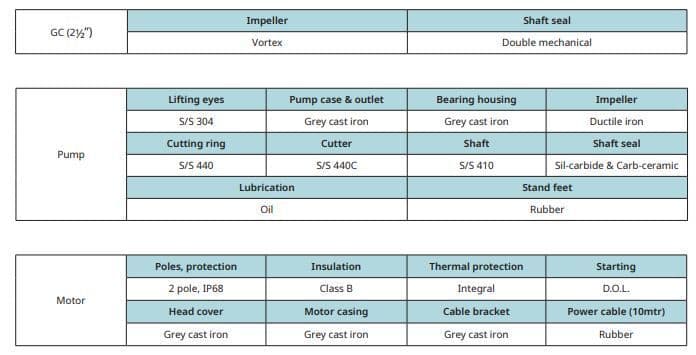
| Pump casing and outlet | Grey cast iron |
| Motor casing and head cover | Grey cast iron |
| Impeller | Ductile iron |
| Cutter | 440C stainless steel |
| Cutting ring | 440 stainless steel |
| Shaft | 410 stainless steel |
| Shaft sealing | Double mechanical seals in an oil chamber |
| Seal materials | Silicon carbide and carbon ceramic |
| Lifting eyes | 304 stainless steel |
| Liquid temperature | 0–40°C |
| Liquid pH range | 6–8 |
| Maximum immersion depth | 8m |
| Motor protection rating | IP68 |
| Insulation class | Class B |
| Thermal protection | Integral |
| Starting method | Direct-on-line |
Performance: maximum flow and maximum head are separate limits and are not achieved simultaneously. Actual delivery depends on the complete discharge system. Maximum immersion depth describes how deeply the pump can be submerged; it is separate from pumping head.
Power: the stated kW figures are motor output ratings. They are not electrical-input figures and should not be used directly to calculate electricity consumption.
Liquid suitability depends on the complete composition of the wastewater, not pH alone.
What is supplied
The standard supply comprises:
-
The selected GC50 or GC75 sewage grinder pump in its free-standing configuration.
-
A 10m heavy-duty rubber power cable.
The grinding mechanism is incorporated into the pump. Automatic level controls, a separate control panel, discharge pipework and the optional guide-rail coupling are selected separately.
Useful optional accessories
-
Suitable three-phase starter or control panel: provides correctly rated motor switching and protection.
-
Level switches or level sensing: enables automatic operation at levels appropriate to the chamber and pump.
-
High-level alarm: warns of a rising wastewater level.
-
TOS-G3 auto-coupling and suitable guide rails: provide a removable mounting arrangement for a permanent installation.
-
Pressure-rated discharge pipework or hose: selected for the required flow, route and system pressure.
-
Compatible connection fittings, non-return valve and isolation valve: complete the discharge arrangement and support maintenance.
-
Suitable lifting equipment: allows the pump to be installed and removed using its lifting points.
Practical selection advice from Henry Pumps
A high-head sewage pump should be selected around the required flow at the working head, the waste being handled and the installation’s control requirements.
Henry Pumps is an independent specialist offering practical help with pump selection, discharge pipework, fittings and controls. Tell us the water or effluent type, vertical lift, discharge distance, pipe size, available supply and chamber arrangement so we can help assess the GC50 or GC75 for your application.
Call 0333 050 3748 or email sales@henrypumps.co.uk.
Customer reviews
-
Condition:New
-
Product Code:15101106
-
Weight:80kg
Suitable for
- Shared sewage pumping stations
- Long or uphill rising mains
- Industrial fibrous effluent
- Agricultural effluent systems
Not suitable for
- 230V or 110V supplies
- Unattended automatic pumping as supplied
- Hard debris and abrasive slurry
- Seawater, aggressive chemicals or fuels
Frequently Asked Questions
The GC50 has a 3.8kW motor output, a maximum flow of 330 litres per minute and a maximum head of 42m. The GC75 has a 5.6kW motor output, a maximum flow of 350 litres per minute and a maximum head of 50m.
Both require 400V three-phase power and are supplied for manual operation. The GC75 provides additional head capability, so compare the flow each pump can deliver against your installation’s total resistance.
Head describes the resistance the pump can overcome, expressed in metres of liquid. It includes the vertical lift and losses caused by the discharge pipework.
These pumps are intended for duties requiring greater pressure capability, such as an uphill discharge or a long rising main. The maximum head is reached at effectively zero flow, so a 50m maximum-head rating does not mean the GC75 will deliver 350 litres per minute through a system requiring 50m of head.
No. Both models are supplied for manual operation and have no supplied automatic float-switch arrangement.
Automatic operation requires suitable level controls and a correctly rated starter or control panel. The system should provide appropriate starting and stopping levels, motor protection and protection against running with insufficient liquid.
They can be considered for properly designed systems handling compatible, pumpable effluent, including suitable distribution systems requiring higher pressure.
Check the liquid composition, solids, required flow and pressure before selection. Any sprinkler or distribution equipment must also suit the effluent and remaining particles. Grinding reduces suitable solids; it does not treat or disinfect the liquid.
Plan access for inspection of the grinding components, impeller, seals, cable and controls. Cutter or cutting-ring wear can affect grinding performance, while accumulated debris can interfere with operation.
Maintenance requirements depend on the waste stream and duty. Isolate the pump before inspection, use appropriate lifting equipment and follow the supplied operating instructions. A guide-rail arrangement can make removal for servicing more convenient.
Buy with confidence
At Henry Pumps, we support residential, commercial, and industrial customers, from homeowners and landlords to contractors and facilities teams. Based in Derbyshire, we help solve flooding, drainage, and water management challenges across the UK. Every pump we supply is chosen for proven reliability and performance, backed by expert, straightforward advice you can trust. Whether you’re maintaining a property, managing a building, or dealing with an urgent issue, we’ll help you find the right solution.