
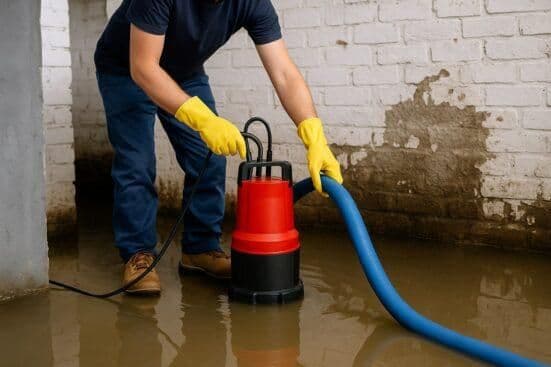
A wet basement or cellar is one of the most common and damaging water problems in UK properties, and a submersible drainage pump is the most practical solution available for managing it. Whether the issue is a recurring seasonal inundation, groundwater ingress through walls and floor, or the risk of flooding from a nearby watercourse, the right pump installed correctly in a properly designed sump provides reliable, largely automatic protection that limits water damage to a manageable level.
Choosing the wrong pump, or installing the right pump without the correct supporting components, produces a system that fails at the moment it is most needed.
This guide covers every decision involved in specifying a submersible drainage pump for a basement or cellar application.
Understanding the Water You Are Dealing With
The first specification decision is understanding the nature of the water entering the basement. Groundwater seeping through walls and floors is typically clean or lightly contaminated with fine sediment and mineral deposits. Surface water flooding entering through doorways, window wells, or area drains carries significantly more sediment, organic material, and debris. Sewage contaminated floodwater is a separate category requiring a sewage rated pump rather than a standard drainage pump.
This distinction matters because pump impeller design and material are matched to the type of water being handled. A clean water pump used to handle silt laden flood water will suffer rapid impeller wear. A pump rated for light solids handling up to 10mm particle size is the appropriate minimum specification for any basement that receives surface water inundation. Where the water source is primarily groundwater seepage through walls, a clean water or lightly contaminated water rating is adequate. The submersible drainage pumps range covers models rated for both clean groundwater and dirty water containing solids, across a range of flow rates suited to basement and cellar applications.
Sizing the Pump: Flow Rate and Head
The pump must deliver sufficient flow to clear water from the basement faster than it enters during the worst anticipated inflow event. Calculating the required flow rate involves estimating the maximum inflow rate in litres per minute, which depends on the source of the water and the severity of the events the pump is being specified to handle.
For groundwater seepage through walls and floor, inflow rates are typically modest and a pump delivering 100 to 300 litres per minute at the operating head is generally adequate. For surface water flooding entering through openings, the inflow rate can be considerably higher and depends on the size of the openings and the depth of water outside. In the latter case, no pump can match an unconstrained inflow through a large opening: the pump's role is to clear residual water once the inflow has subsided rather than to combat active ingress at full rate.
Total head for a basement pump is the vertical height from the sump floor to the discharge point outside the building, plus friction losses through the discharge pipework. Most basement and cellar installations have a total head of two to five metres, which is within the comfortable operating range of most compact submersible drainage pumps. Always check the pump's published performance curve at the actual head rather than relying on the zero-head flow figure.
Automatic vs Manual Operation
For a permanent basement installation, automatic operation via a float switch is strongly recommended over manual control. The value of a basement drainage pump is greatest when no one is present to operate it: during the night, while the property is unoccupied, and during the early stages of a flood event when water may be rising unnoticed. A manually operated pump that is not switched on provides no protection at all.
Float switches can be integral to the pump design, providing a compact self-contained automatic unit, or can be added as a separate component to a manually operated pump. The float switch start level should be set to activate the pump before water reaches any vulnerable fittings, electrical connections, or floor surfaces in the basement. The stop level should be set to clear the sump to as low a level as the pump can reliably achieve, maximising the available sump storage volume for the next inflow event. The flood defence pumps range covers complete automatic systems with integral float switches ready for installation into an existing or new sump.
Puddle Pump Capability
A standard submersible drainage pump typically leaves 50mm to 150mm of water in the sump after the float switch stops it, because the pump inlet requires a minimum water depth to operate. This residual water accumulates over multiple events and reduces the available sump storage capacity over time. A pump with puddle pump capability, either a dedicated puddle pump or a drainage pump with a low level inlet design, can reduce the sump level to within a few millimetres of the floor after each cycle, maximising sump storage and keeping the basement drier between events.
For basements with a shallow sump or where the floor level is critical, puddle pump capability is worth specifying even if it adds some cost. The difference between a sump that empties to 3mm and one that leaves 100mm is meaningful in a confined sump where total storage volume is limited.
Sump Design and Discharge Routing
The pump performance is only as good as the sump it sits in. A sump that is too small fills rapidly and requires the pump to run almost continuously during a significant inflow event, reducing the working life of the motor through accumulated run hours. A correctly sized sump with a volume adequate to buffer the inflow between pump cycles allows the pump to operate in defined on and off cycles rather than running continuously.
The discharge pipe must be routed to a point outside and well away from the building, discharging to a drain, soakaway, or watercourse that can accept the flow without backing up into the building. A non-return valve on the discharge side is essential: without one, water flows back through the pipe into the sump when the pump stops, re-triggers the float switch, and causes the pump to short cycle on the returning water. The non-return valve should be installed as close to the pump outlet as is practical, before any rise in the discharge pipe that would allow backflow to accumulate.
Power Supply and Electrical Safety
The electrical installation for a basement drainage pump must comply with current wiring regulations, including RCD protection appropriate for the damp or wet environment. The pump should be connected to a dedicated circuit rather than a shared socket to prevent inadvertent disconnection. Where the pump is installed in a location that may be submerged during a flood event, the electrical connection point must be above the anticipated maximum flood level to remain accessible and safe during operation.
For properties where mains power reliability during flood events is a concern, a battery backup unit that maintains pump operation through a power outage provides critical protection at the moments when a pump failure has the most serious consequences. The broader borehole pumps range covers additional submersible pump options where groundwater management extends beyond the basement to a broader private water supply context.
Frequently Asked Questions
What size sump do I need for a basement drainage pump?
A sump of at least 200 to 300 litres capacity is recommended for most domestic basement installations; larger sumps reduce pump cycling frequency and extend pump life, and the right size depends on the anticipated inflow rate and the pump's flow capacity.
Can I use a garden pump for basement drainage?
No; garden pumps are designed for clean water and will suffer rapid damage if used to handle the silt-laden water typical of basement flooding; a dedicated submersible drainage pump rated for dirty water is the correct specification.
How often should a basement drainage pump be tested?
Testing every three to six months by pouring water into the sump and confirming the pump starts, runs, and stops correctly is recommended; testing before the autumn and winter flood risk season is particularly important.
Do I need a non-return valve with a basement sump pump?
Yes; a non-return valve on the discharge side prevents water flowing back into the sump when the pump stops, which would otherwise cause repeated short cycling on the returning backflow and increase pump wear significantly.
Final Thoughts
A correctly specified submersible drainage pump in a well-designed sump, operating automatically via a float switch with a properly routed discharge and a non-return valve on the outlet, provides reliable long term protection for a wet basement or cellar with minimal ongoing maintenance.
The key specification decisions are matching the pump to the water type and inflow rate, choosing automatic operation for unattended protection, and designing the discharge route to prevent backflow and re-entry of discharged water.
Browse the full range of submersible drainage pumps and basement flood protection equipment at Henry Pumps to find the right pump and accessories for your basement installation.