
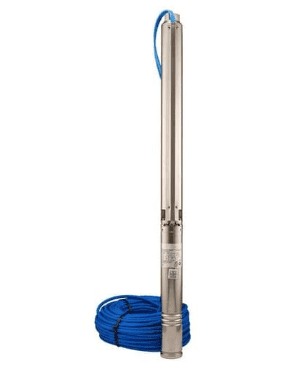
Selecting a borehole or well pump is not as straightforward as picking by price or brand. Install the wrong pump and you will get inadequate flow, burn out the motor prematurely, or find you have specified something too large to fit the casing.
Getting it right requires knowing a handful of key parameters about your water source and your demand before comparing products. This guide covers each of those parameters clearly, so you can specify with confidence and avoid the most common sizing mistakes.
Understand Your Borehole Diameter First
The borehole or well casing diameter is the first constraint you need to establish. Submersible borehole pumps are sized in inches corresponding to the minimum internal casing diameter they require. The most common sizes in the UK are 3 inch and 4 inch, with 5 inch and 6 inch pumps used for higher output agricultural and commercial applications.
A 4 inch pump will not fit in a 3 inch borehole. This sounds obvious, but it is a surprisingly common source of ordering errors, particularly when buyers focus on flow rate and price before checking physical compatibility. If you are unsure of your borehole diameter, measure the internal diameter of the casing liner before ordering anything.
Calculate the Flow Rate You Actually Need
Flow rate is measured in litres per minute or cubic metres per hour and describes how much water the pump can deliver at a given pressure. You need to match this to your actual demand rather than simply buying the highest rated pump available.
For domestic supply and garden irrigation, modest flow rates are typically sufficient. Agricultural applications including crop irrigation and livestock watering require significantly higher output, usually served by larger 4 or 5 inch multi-stage pumps. Oversizing a pump is not without consequence: running a large pump to supply a small demand causes rapid on-off cycling, increasing wear and shortening motor life. Size for peak demand and consider all simultaneous uses before settling on a specification.
Know Your Total Head Requirement
Total head combines the depth from which water needs to be lifted (static head) with the resistance the pump must overcome through the pipework to the delivery point (friction head). A pump rated for adequate flow at low head may deliver very little at your actual depth and delivery pressure.
Every pump comes with a performance curve showing how flow changes as head increases. Understanding this curve is essential for selecting a pump that performs under real operating conditions rather than best case scenarios.
- Static head: vertical distance from the water surface to the highest delivery point
- Friction head: resistance from pipe length, diameter, bends, and fittings
- Total head: static head plus friction head combined
Power Supply and Voltage
Most domestic borehole pumps operate on single phase 230v, which is the standard UK domestic supply. For higher output pumps in agricultural or commercial settings, three phase 400v supply is common and typically necessary to run larger motors efficiently. Attempting to run a three-phase pump on single-phase supply is not viable without a phase converter, which adds cost and complexity.
If your installation is in a remote location without a mains connection, solar powered borehole pump kits are a practical alternative. Modern solar borehole systems using MPPT controllers and permanent magnet motors can deliver reliable output even in variable light conditions, making them well suited to off-grid agricultural watering and rural domestic supply.
Water Quality and Suspended Solids
If your borehole produces water containing sand, silt, or suspended solids, this must influence your pump selection. Standard clean water only pumps suffer accelerated impeller wear and premature failure in silty conditions. Some pumps are rated to handle water with defined concentrations of suspended solids, expressed in grams per cubic metre. If your water has any turbidity, specify a pump with this tolerance or add a sand filter at the outlet to protect downstream components.
Submersion Depth and Cable Length
Every borehole pump has a maximum rated submersion depth, and exceeding it risks motor damage and voids the warranty. Most domestic pumps are rated to 20 metres, covering the majority of UK shallow well applications. Deeper boreholes require pumps with higher submersion ratings and appropriately rated cables.
Cable length is also a practical consideration. Most pumps are supplied with a standard cable, typically between 1.5 and 20 metres depending on the model. If your borehole is deeper than the supplied cable, you will need jointing kits or an extended cable option. Always check the supplied length against your installation depth before ordering.
You can browse the full range of borehole and well pumps across 3 inch, 4 inch, and 5 inch sizes, including solar powered options and models rated for suspended solids, to compare specifications against your requirements.
Frequently Asked Questions
What is the difference between a borehole pump and a well pump?
The terms are often used interchangeably, but borehole pumps are typically designed for narrow, drilled boreholes while well pumps may suit wider, shallower dug wells, though many submersible models are specified for both.
Can I use a borehole pump for irrigation?
Yes, multi stage submersible borehole pumps are widely used for agricultural and garden irrigation and are available in flow rates suited to everything from smallholdings to larger-scale crop watering.
Do I need planning permission to install a borehole pump in the UK?
Installing the pump itself does not require planning permission, but abstracting more than 20 cubic metres of water per day from a borehole does require an abstraction licence from the Environment Agency in England.
How long do borehole pumps typically last?
A correctly specified and properly installed borehole pump from a quality manufacturer can last 10 to 20 years, though lifespan is heavily influenced by water quality, duty cycle, and whether the pump is correctly protected against dry running.
Can a borehole pump run dry?
Running dry, where the water level drops below the pump intake, causes rapid overheating and motor damage; most quality pumps should be fitted with a low water cutoff or float switch to prevent this.
Final Thoughts
Choosing a borehole pump is primarily an exercise in matching the pump's performance to the physical realities of your installation. Borehole diameter, total head, flow demand, power supply, and water quality all need to be established before comparing products. Skipping any one of these steps risks specifying a pump that underperforms, wears prematurely, or simply will not fit.
For those unsure where to start, most reputable suppliers will help you work through the specification if you can provide the key measurements. Browse the complete range of submersible borehole and well pumps at Henry Pumps to find the right model for your application across domestic, agricultural, and off-grid uses.