
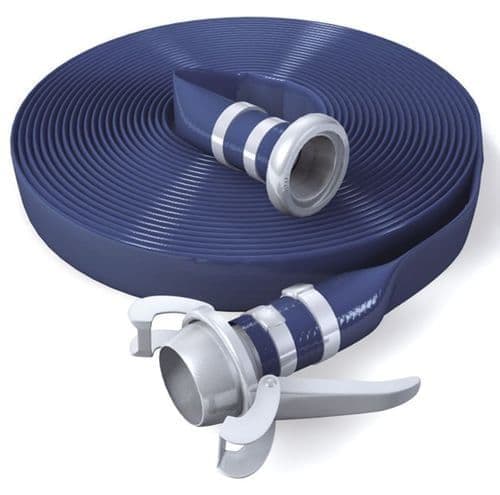
A pump is only as effective as the hose it is connected to. On a construction or civil engineering site, a poorly specified hose run brings a dewatering operation to a halt as quickly as a pump failure: a suction hose that collapses under vacuum, a discharge hose that bursts under pressure, a bore that is too small and starves the pump of flow, or a coupling system that takes too long to connect and disconnect under site conditions.
The hose specification for a dewatering job deserves the same attention as the pump specification, and the decisions involved are straightforward once the principles are understood.
This guide covers the hose types available for site dewatering, how to match bore size to the pump, which hose to use on the suction and discharge sides, and how the Bauer coupling system simplifies site deployment.
The Two Sides of a Pump: Suction and Discharge
Every pump in a dewatering system has two hose connections that perform fundamentally different duties. The suction hose runs from the water source to the pump inlet, drawing water toward the pump under negative pressure. The discharge hose runs from the pump outlet to the disposal point, carrying water away from the pump under positive pressure. These two duties place very different demands on the hose, and the most common and costly hose specification error in site dewatering is using a pressure hose on the suction side.
A pressure only hose such as layflat collapses immediately when subjected to suction, because the hose wall relies on internal pressure to maintain its shape. Layflat hose has no structural resistance to collapse under vacuum. On the suction side of a pump, it will flatten, restrict flow to near zero, and potentially cause the pump to cavitate and overheat within minutes. Suction rated hose, which has a reinforced wall or an internal helix that prevents collapse under vacuum, must always be used on the suction side regardless of how convenient or available a pressure hose might be on site.
Hose Types for Site Dewatering
Four principal hose types cover the dewatering duties encountered on UK construction and civil engineering sites:
- Layflat hose: a flexible woven discharge hose that flattens when empty and rolls compactly for storage and transport; it is the lightest and most easily managed discharge hose for a given bore size and the standard choice for surface discharge runs in most dewatering applications; it must only be used on the discharge side of the pump
- MDS (medium duty suction) hose: a semi-rigid hose with a reinforced wall that resists collapse under moderate suction conditions; suitable for both suction and discharge duties, making it the most versatile option for applications where the same hose sections may be used in either role; the appropriate choice for suction runs where the vacuum is not extreme and the suction lift is moderate
- Wire armoured suction hose: the highest specification suction hose, incorporating a steel wire helix embedded in the hose wall that provides maximum resistance to collapse under high suction conditions; the correct specification for the suction side of high-flow engine driven pumps drawing from excavations, sumps, or open water sources where suction head and flow velocity are at their highest; available in 2, 3, 4, 6, and 8 inch bore sizes
- MDS hose with Bauer fittings: medium duty suction hose pre-assembled with Bauer type lever lock couplings at both ends; provides the versatility of MDS with the rapid connection and disconnection of the Bauer system; suited to operations where the hose configuration needs to change frequently as the dewatering progresses
The complete range of pump hose and site accessories covers all four hose types in standard bore sizes and lengths, with Bauer fitted assemblies available for immediate deployment without site fitting.
Matching Bore Size to the Pump
Bore size is the most consequential hose specification decision and the one most frequently underestimated. The hose bore must match the pump's inlet and outlet port diameter throughout the full suction and discharge run. Reducing the bore at any point in the system creates a restriction that limits the maximum flow the pump can deliver, increases water velocity in the narrowed section, and generates friction losses that reduce effective pump output.
The relationship between bore size and friction loss is non linear: halving the hose diameter increases friction loss by a factor of sixteen for the same flow rate. A 3 inch pump running through a short section of 2 inch hose will be significantly more restricted than the bore reduction alone suggests. Confirm the bore size of every section of hose, every coupling, and every fitting in the suction and discharge run before deploying. The pump's rated flow is only achievable when the entire hose system is sized to allow it.
The Bauer Coupling System on Site
The Bauer type lever lock coupling is the standard quick release connection system for site dewatering hose across the UK and Europe. The cam and lever mechanism allows hose sections to be connected and disconnected in seconds without tools, a critical advantage when repositioning a pump as the water level drops in an excavation or when extending a discharge run as the work progresses across a site.
The Bauer system is standardised across manufacturers, so assemblies and fittings from different suppliers interconnect freely provided the nominal bore size matches. This interchangeability is useful on large sites where hose from multiple sources may need to be combined. Pre-assembled Bauer type hose assemblies in layflat, MDS, and wire armoured configurations are stocked in standard lengths and ready for deployment without any site preparation.
Discharge Route Planning
The discharge hose run determines the total head the pump must overcome in addition to the suction lift and the friction losses in the suction hose. A longer discharge run with multiple bends and a significant vertical rise adds to the total system head and reduces the effective flow the pump delivers at the discharge point. Planning the discharge route before the pump starts and keeping the run as short and direct as possible with the minimum number of bends maximises pump output and reduces wear on the hose system.
Where the discharge hose must cross a road, footpath, or vehicle access route, a hose ramp protects the hose from vehicle damage and eliminates the trip hazard that an unprotected hose crossing creates. The engine driven pumps typically used for larger dewatering duties are designed to work with the full range of site hose assemblies. The engine driven pumps range covers the principal petrol and diesel dewatering pump models stocked for UK site use, with inlet and outlet port sizes confirmed in each product specification for direct hose bore matching.
Frequently Asked Questions
Can I use layflat hose on the suction side of a dewatering pump?
No; layflat hose is a pressure only hose that will collapse immediately under suction; wire armoured suction hose or MDS hose must always be used on the suction side of any dewatering pump.
What happens if the suction hose bore is smaller than the pump inlet?
A suction hose smaller than the pump inlet creates a restriction that limits the flow the pump can draw, reduces output below the pump's rated performance, and increases the risk of cavitation if the pump attempts to exceed the flow the restricted hose allows.
How long can a discharge hose run be for a site dewatering pump?
There is no fixed maximum, but every additional metre of hose and each bend adds friction loss that reduces effective pump output; the pump's performance curve should be checked at the estimated total system head to confirm adequate flow will be achieved at the full discharge run length.
Are Bauer type couplings interchangeable between different manufacturers?
Yes; the Bauer type coupling is a standardised system and assemblies from different manufacturers will connect correctly provided the nominal bore size matches, making it straightforward to combine hose from different sources on site.
Final Thoughts
Hose specification for site dewatering comes down to three rules: always use suction rated hose on the suction side, match the bore throughout the full run to the pump's port diameter, and use a coupling system that allows fast reconfiguration as the job develops.
Getting these right means the pump delivers its rated performance from the first hour on site rather than being limited by a hose system that restricts it.
Browse the full range of site dewatering pumps and pump hose at Henry Pumps to find the right combination of pump, suction hose, and discharge hose for any dewatering application.