
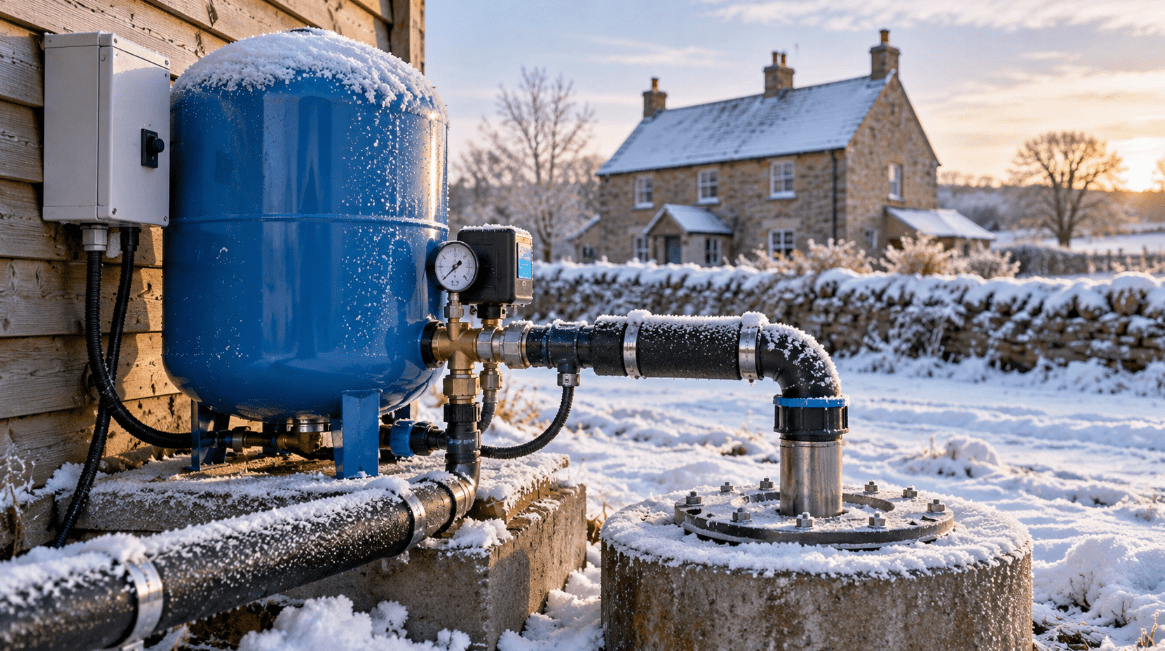
The borehole pump itself, submerged tens of metres below ground in water that maintains a near constant temperature year round, is largely unaffected by cold weather. The problems that cause borehole pump systems to underperform or fail in winter are almost all above ground: in the pipework between the borehole head and the property, in the pressure vessel and pressure switch housed in an unheated outbuilding, in the surface level connections exposed to frost, and in the electrical supply that becomes unreliable during storms.
Understanding where the vulnerability lies, rather than assuming the pump is the cause of a winter problem, is the starting point for effective cold weather protection of any borehole water supply.
Where Borehole Systems Are Actually Vulnerable to Cold
Groundwater in a UK borehole typically remains at eight to twelve degrees Celsius year round, regardless of surface temperatures. The submersible pump and rising main below the frost line are at no direct risk from freezing. The vulnerabilities are entirely in the above ground components:
- The wellhead and borehole cap: surface water can penetrate a poorly sealed borehole cap and freeze around the rising main connection, potentially cracking the cap assembly or restricting the main where it passes through the head plate
- The rising main above ground: any section of rising main that exits the borehole and runs above ground before entering a building, even a short exposed section, is vulnerable to freezing if not insulated
- The pump house or plant room pipework: pressure vessels, pressure switches, gate valves, and associated pipework installed in unheated outbuildings or exposed meter housings are the most commonly frozen components in a domestic borehole system; a pressure vessel containing water in an unheated shed will freeze in a prolonged hard frost
- The supply pipework to the property: where the buried supply pipe from the borehole to the property is not laid at sufficient depth below the frost line, typically 750mm or more in UK conditions, it can freeze during sustained cold periods
The borehole and well pumps range covers the submersible pumps used in UK domestic and agricultural installations, but protecting the system through winter requires attention to the full above-ground installation rather than the pump alone.
Frozen Pressure Vessels and Plant Rooms
The pressure vessel is statistically the most commonly frozen component in a domestic borehole system, and the damage it sustains when frozen is both serious and expensive to address. A pressure vessel contains water on one side of its internal bladder at all times when the system is pressurised. In an unheated outbuilding, that water will freeze in a sustained hard frost. The bladder, the vessel shell, and the associated fittings and pipework are all vulnerable to the expansion pressure of ice formation.
A frozen pressure vessel typically suffers bladder rupture, which causes waterlogging and pump short cycling when the system thaws. In more severe cases the vessel shell itself is damaged, or the pipework connections fracture at threaded joints where the combination of the pipe's rigidity and the ice expansion has nowhere to go. Either failure means no water supply until repairs are completed, which in a property relying entirely on a private borehole supply can be a serious situation.
The solution is straightforward: the pump house or plant room housing the pressure vessel and associated components must be insulated and, where necessary, heated. A thermostatically controlled frost protection heater set to maintain the plant room above four degrees Celsius is the minimum provision for any borehole installation where the plant room is not heated by the property itself. The pressure vessels range covers replacement vessels across the full capacity range when a frozen vessel needs replacing, but prevention through adequate plant room heating is considerably less costly than a mid-winter replacement.
The Wellhead: Sealing Against Surface Water Ingress
The borehole cap at surface level seals the top of the borehole casing and provides the entry point for the rising main, power cable, and any monitoring cables. A cap that has deteriorated, cracked, or lost its seal allows surface water to enter the top of the borehole. In summer this creates a contamination risk. In winter, water that has entered the cap assembly and sits around the rising main connection can freeze and expand, cracking the cap or damaging the rising main where it passes through the head plate.
An annual inspection of the wellhead before winter, checking the condition of the cap, the integrity of the seal around the rising main entry point, and the condition of any surface level electrical connections, takes twenty minutes and catches deterioration before it becomes a winter failure. Any cracked or deteriorated cap should be replaced before the cold season rather than monitored through it.
Electrical Supply Resilience During Winter Storms
Rural properties with private borehole supplies are disproportionately affected by storm related power outages. A borehole pump without power provides no water, and in a property with no mains water backup the consequences of an extended outage are significant. Winter storms that coincide with freezing temperatures compound the problem: the property loses both heating and water supply simultaneously.
Two levels of electrical resilience are worth considering for borehole installations in areas with unreliable winter power supply. A generator connection point, allowing a portable generator to be quickly connected to the pump circuit during an outage, provides backup at relatively low cost and is practical for most rural properties where a generator is already kept for other purposes. A permanently installed uninterruptible power supply sized to run the pump for several hours provides automatic, seamless backup without any manual intervention, which is more relevant for properties where no one may be present during an outage.
Reduced Yield in Winter: When the Aquifer Responds to Seasonal Change
Some boreholes in the UK experience reduced yield in winter, which might seem counterintuitive given that winter is typically a wetter season. The apparent contradiction resolves when the geology is understood: in chalk and limestone aquifers that respond relatively quickly to surface recharge, winter rainfall does increase groundwater availability over time. But in clay dominated catchments where surface saturation prevents rainfall from percolating to the aquifer quickly, or in boreholes where the aquifer is already under stress from a dry preceding summer, winter yield may not recover as expected.
A borehole that shows reduced pressure and flow in winter, after the above ground components have been confirmed as functioning correctly, may be experiencing genuine aquifer yield reduction. In this case, reducing the pump's operating flow rate to match the available yield, or lowering the pump setting depth if there is adequate casing depth available, are the appropriate responses rather than assuming the pump has failed. The broader booster pumps range covers supplementary pressure boosting options where yield constraints limit the borehole pump's ability to maintain adequate delivery pressure to the property.
Frequently Asked Questions
Can a submersible borehole pump freeze?
The submersible pump itself is extremely unlikely to freeze as it operates below the frost line in groundwater that maintains a near constant temperature year round; the vulnerable components are the above-ground plant room equipment, pipework, and wellhead connections rather than the pump itself.
What temperature should a borehole plant room be kept at in winter?
A minimum of four degrees Celsius is the standard recommendation to prevent freezing of water-containing components; a thermostatically controlled frost protection heater set to this temperature provides reliable protection in all but the most extreme UK winter conditions.
Why has my borehole lost pressure in cold weather?
The most common cause is a frozen or waterlogged pressure vessel in an unheated plant room; other causes include a frozen section of above ground pipework, a partially frozen pressure switch that is not operating correctly, or a wellhead that has allowed surface water ingress and frost damage at the rising main connection.
How do I protect borehole pipework that runs above ground?
Any above ground section of rising main or supply pipework should be lagged with foam pipe insulation of adequate thickness and, in exposed locations prone to prolonged hard frost, supplemented with self regulating trace heating cable beneath the insulation.
Final Thoughts
The borehole pump itself is one of the more winter resilient components in a private water supply system, but the above ground installation it connects to is not. Protecting the plant room from frost, maintaining the wellhead seal, confirming the supply pipework is adequately buried or insulated, and having a plan for power supply resilience during winter storms are the four actions that determine whether a private borehole supply continues to perform reliably through the coldest months of the year.
Browse the full range of borehole pumps and pressure vessels at Henry Pumps for expert guidance on protecting and maintaining any private borehole installation.